ISSUE 2
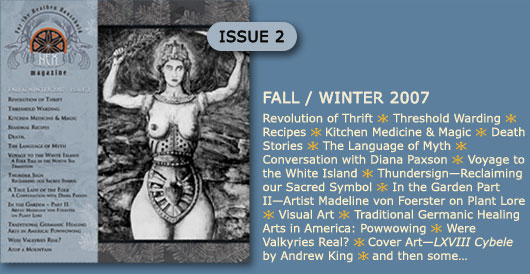
Articles Available Online:
- REVOLUTION OF THRIFT ~ An Incitement from the EditorsWhat can we do about the materialistic runaway-train that drives many of the culturally and spiritually degrading views of modern society? For one, it is high time for us to let go of the destructive habits of consumerism. We must reclaim the thrifty mindset of yesterday in order to create a better tomorrow…and it all starts at home.
- Threshold WardingOur thresholds have a strong bearing, spiritually speaking, on our entire house. What we do at this entry to our InnanGarth, our private sanctuary, is of vital importance to the strength of both ourselves and our surroundings.
- Kitchen Medicine & Magic ~ RootsThis second issue will attempt to uncover some of the roots buried in our Heathen Kitchens, for use in Medicine and Magic…at least the roots of underground vegetables. Roots were certainly well known kitchen ingredients before the age of fast foods and frozen dinners, but as Odin will tell you…“...no man knows from where...the roots run.”
- A True Lady of the Folk To those already immersed in neo-Heathen culture, Diana L. Paxson hardly needs an introduction. To those just dipping their toes in, we are pleased to bring you a leading woman in the traditional Pagan movement.
- Yule Ham – Julskinka/JuleskinkeHere is a recipe for Jule Ham that takes only two weeks to brine and provides a nice “soup” into which the whole family can dip.
- FermentationFermented food provides the body with probiotics, which are beneficial bacteria that started colonizing our bodies thousands of years ago. They also provide amino acids, vitamins and minerals, boost immunity, and help the body to digest, and absorb essential nutrients. They are detoxifying, and powerfully anticarcinogenic.
- Ginger CakeHere is a spicy ginger cake that you can serve year round, but tastes best in cold weather, during your winter festivities.
- GoulashPorkolt is a hot dish which originates in Hungary that we generally refer to as Goulash. Porkolt is derived from the Hungarian verb porkolni which means “to roast” or “to singe” the meat.
- Feline FoodMaking your own home made cat food may seem like a daunting endeavor at first. But with a relatively little amount of planning and effort you can create delicious and nutritious gourmet meals for your feline family members.
- Carrot CakeThis cake tastes wonderful plain or with icing, and in fact one can be left plain and the other cut into two cakes horizontally and iced as a layer cake.
- Atop A MountainIn the midst of fog Penetrated by moonlight, do I stand.
- Darradtharljodth (Song of the Spear) ~ Poem from Njal's Saga referred to in "Were Valkyrie's Real?"
- Slaw SaladPlace cabbage in large glass, ceramic or plastic bowl and sprinkle with vinegar, mix well and let macerate for 5 minutes.
- Artwork Issue 2
Articles Only in the Printed Publication / PDF:
- Death.Death stories by four people: Amie, Julius, Arrowyn, and Gerhard.
- The Language of MythTo say that ‘Indo-European’ is a term many Heathens have come across at least once or twice would be a grand understatement. Unfortunately there is not, to my knowledge, a single book dealing with this subject currently available on the market written specifically for a Heathen readership and based on a sound understanding of the topic. While unquestionably relevant to Heathenism, the subject of comparative Indo-European language, culture, and myth has received cursory and often inexpert attention from Heathen authors. The Language of Myth is my attempt to correct that—at least in part. It is a recurring column intended to highlight the relationships and evolution of various Heathen mythic themes and cultural ideas, as well as the vocabulary used to describe them. None of the ideas discussed in this column are intended to be original or innovative. My purpose here is to provide a summary of information, on selected topics, compiled from various sources. I will also supply a list of works that interested readers may be inclined to seek out.Article by Antonius Block.
- Thunder Sign ~ Reclaiming Our Sacred SymbolThink of the most sacred thing in your life. Think of the most precious thing in your life. And then, put the swastika into that place. Put the swastika into your heart. Put the swastika on your altar. Put the swastika on the image you use to represent god, love, peace, or the cosmos. Put the swastika on the thing that makes you happy. You will begin to see what the swastika has meant to humans over this entire planet for all of our human history. For these places are exactly the places it occupied for thousands of years until the Second World War.For more amazing, worldwide swastika history illustrated by 400 rare photos, see my book Gentle Swastika: Reclaiming the Innocence. You can also go to my Friends of the Swastika website at www.manwoman.net. Article by ManWoman.
Note from the Editors:
Now that you are aware, look for swastikas all around you—in textiles, in architecture, all over our cities, in the logos of companies, in nature. They are everywhere—a powerful symbol in our collective consciousness.Note from Markus Wolff:
For an in-depth overview of this universal symbol, please also seek out Thomas Wilson’s 1897 landmark study The Swastika, available as a PDF file from the excellent Northvegr website. Of course, this book is somewhat dated and it is a sad state of affairs that no thorough scientific study of this symbol has been undertaken in the English language. [click here] - In the Garden ~ Part IIWhat plants contribute to our world is something beyond measure, or even description. It is common to view plants as nonentities separate and less important than ourselves, without comprehending that their existence is the keystone of our own. Their minute alchemy transforms inorganic matter into something we can ingest, transforms carbon dioxide into something we can inhale. In the web of life on Earth, plants provide the most significant strands.My painting, In the Garden, is my love-letter to Kingdom Plantae. Surrounding us are plants with myriad and marvelous properties, each unique species able to fulfill some different exigency of our bodies or spirits. They feed us, shelter us, clothe us, heal us, intoxicate us, and delight us with their beauty and fragrance. Abstractly, they decorate our temples and bodies, inspire our myths, and give us comfort with their very beings.The style of In the Garden is inspired by the tapestries of medieval Europe, a period in which the divide between medicine, botany, and art did not yet so clearly exist. Looking at these tapestries, so richly embellished with botanical images, one is amazed at how carefully the plants are depicted—individual species are readily discernible. An astounding amount of toil is required for such detailed weaving. Becauseof this source of inspiration, and my interest in the medieval era in general, I thought it would be interesting to explain what some of the plants I selected for the painting meant—their symbolism, usage, folklore, and history. With one or two exceptions, the plants in the painting were familiar to medieval Europeans, and can be easily found in art from that era.Article by Madeline Von Foerster.
- Traditional Germanic Healing Arts in America: Powwowing Most of us are familiar with the history of the Salem witchcraft trials, and certainly with the modern emergence of neo-Paganism that began in the latter part of the nineteenth century. It may surprise many, however, to learn that there have been traditional forms of magical healing practiced quietly and inoffensively by certain enclaves of Americans since the first settlement, through colonial times, and to this very day. Such traditions migrated from the old world and have remained hidden to the outside culture or, when discovered, were quaintly characterized as ‘folk religion’ or ‘local healing traditions.’ The practitioners of such arts have not sought the limelight, preferring instead to quietly go about their sacred work.Article by Jack Montgomery.
- Voyage to the White Island ~ A Folk Tale in the North Sea TraditionThe fisherman took a breath of salty morning air as he stepped out of his little house. Raising his nose to the wind, he savoured the feeling for a while. He always hated the stuffy smell of his house, and though it was most certainly cosy together with his wife and children, he could not bear the air in there for longer than the nights he slept. Taking in the early day like this, he couldn’t help but stretch out his arms and close his eyes, letting the sun wash over his face. Though it was a cold day, the shortest one of the year, to be precise, the warmth of the sun gave the fisherman strength. With a content heart, he made his slow way towards where his ship was moored. Only now, as he neared the sea, did he notice that there were many seagulls out over the water today. They screeched at the top of their lungs, as if hailing both the new day and the fisherman himself.Story by Oscar Strik.
- Were Valkyries Real?About the Author (Robert Ward)
Sometime in the early 90s, I came across an ad for a curiously named magazine: The Fifth Path. I wrote the publisher Robert Ward to get a copy which led to further contact and an enduring friendship. The five issues of The Fifth Path proved to be very influential, since it was one of the first magazines to focus on what then was called Apocalyptic Folk (now more commonly referred to as Neofolk) as well as the Heathen ideas frequently associated with that genre of music.After the ‘death’ of that venture, Robert became more and more involved in organised Asatru, and in fact helped introduce me to the phenomenon. He used his graphic arts skills and publishing experience to transform the Asatru Alliance’s magazine—Vor Tru—into an exceptional publication, that could boast greatly improved layout and content. This metamorphosis lasted for about ten issues, from issue 49 to 59. He also authored several articles such as an overview of The Hammer of Thor, The Wild Hunt and reports about Ötzi and the Caucasian Mummies found in China. His vision was to develop Vor Tru as a vehicle to help gain more visibility and respect for Heathenism, a vision not shared by everyone involved, which eventually led to his disillusionment.
During the last years of his life, Robert nevertheless forged ahead with new plans for a Heathen focused magazine called Northwind. It is from this unpublished project, of which he sent me a copy for proofreading, that the present article has been culled. Strangely enough, the first issue of Northwind was to contain an interview with Steve von Till while he had planned to interview Diana Paxson for the second one, so I feel that his article on women warriors is right at home in HEX. In this spirit of kinship, and in Robert’s memory, we are proud to present it here, three years after his untimely passing on September 17, 2004.
~Intro by Markus Wolff
Over the last century the Western World has been reexamining women’s roles in society, both in the present and the past. In the political world, we saw the suffragette and voting rights movements of the early 1900s lead to the feminism of the 60s and 70s. Today we face the still controversial role of women in our armed forces. These changes have also affected the study of archaeology and history. At the start of the century the works of Swiss writer Johann Jakob Bachofen and his theories of an Atlantean Matriarchy exerted much influence, and as it drew to a close the Lithuanian researcher Marija Gimbutas and her theories of a Neolithic Old European Goddess Civilization were championed by feminists and new-agers alike. These ideas have even filtered down into such pop culture entertainment as television’s Xena: Warrior Princess. The purpose of this article is to take a look at the historic role of women warriors in pre-Christian Europe based on both the archaeological record and written sources—factual and fictional—in order to present some new ideas regarding shieldmaidens and valkyries, and perhaps even a new perspective on the nature of the fabled Amazons.
Editor’s postscript:
Robert would no doubt have appreciated the book Warrior Women: An Archaeologist’s Search for History’s Hidden Heroines by Dr. Jeannine Davis-Kimball, an archaeologist whose exciting research seems to at least partially confirm the theories of his article. The work appeared in 2002, after Robert had finished this article in its original form. Please visit the Center for the Study of Eurasian Nomads: www.csen.orgIn the Spring/Summer 2008 issue of HEX, see a follow-up article, by Jennifer Culver, which further explores the Valkyrie archetype and its relevance in the modern world.
EDDIC AND SAGA SHIELDMAIDENS
Below is a list of Shieldmaiden names, a few details about them, and which works from among the Sagas and Eddas they appear in. This is by no means meant to be a complete list.Alvild – Sivard’s daughter who became a shieldmaiden before she married the Dane Alf. She later became a pirate chief who had her own company of shieldmaidens. She had a daughter with Alf named Gurith. History of the Danes, Book VII.
Aslaug – Daughter of Sigurd and wife of Ragnar. She was a shieldmaiden once known as Randolin. Ragnar’s Saga, 10.
Brynhildr / Brünhilde – Either an Icelandic warrior queen or German valkyrie who was made famous by Richard Wagner in his Ring Cycle operas. Nibelungenlied and The Saga of The Volsungs.
Heid – Standard bearer for King Harald followed by a hundred champions and a company of berserkers. Mentioned along with Visma, who might be Visna, so possibly Heid is confused with Hetha. Logurot Saga.
Helreid – Shieldmaiden/Valkyrie. Poetic Edda.
Hervor – The daughter of Angantyr, whom she calls back from the dead to gain possession of his sword Tyrfing, in order to avenge him and his eleven berserkr brothers. Hervarar saga ok Heidthreks konungs.
Hetha – Warrior woman who reigned in Denmark and was posted on the right flank of a wedge-shaped battle line. Chronicon Lethrense IX, History of the Danes, Book VIII.
Lathgerda – Female relative of Norwegian King Sivard who was forced into a brothel by the Swedish King Fro. She was one of many women who joined with Regner in his battle against Fro. Regner credited her energy with his victories. She is described as “a skilled female fighter, who bore a man’s temper in a girls body; with locks flowing loose over her shoulders she would do battle in the forefront of the most valiant warriors.” Regner had to defeat both a bear and a dog to win her as his bride. They had two daughters and one son, named Fidlef. Even though they later divorced, she came to his aid, along with their son and her second husband, when he needed it. History of the Danes, Book IX.
Olof – warrior queen of Saxland who refuses King Helgi, who then rapes her. She becomes pregnant and gives birth to a daughter named Yrsa. She keeps silent about the rape, and Yrsa’s parentage, treating her like a servant girl. Helgi eventually meets and marries his own daughter Yrsa. Olof takes her final revenge on Helgi by revealing to Yrsa that she is her mother and that she has married her own father. The Saga of King Hrolf Kraki.
Rusila – Norwegian shieldmaiden at the battle of Bravalla who may possibly be Inghen Ruaidh (Red Daughter) who was the leader of some of the Vikings who attacked Munster in The War of the Gaedhil with the Geill. She is described as “surpassing a woman’s temperament in her strenuous military activities.” She fought with her brother for the throne of Norway. History of the Danes, Book IV, VII, VIII.
Sela – Sister of Koller, described as “a warring amazon and accomplished pirate” who was killed by Orvendil, the slayer of her brother. History of the Danes, Book III.
Siggrlinn – Human Valkyrie and love of Helgi. Helgavidtha Hjorvardthzsonar.
Stikla – Norwegian girl who, to preserve her chastity, “stole away from her fatherland, preferring the sphere of war to that of marriage.” She was a contender against Rusila and Olaf, King of the Thrinds, for a kingdom in Sweden. History of the Danes, Book VII.
Svava – Human Valkyrie and lover of Helgi. Helgavidtha Hjorvardthzsonar.
Vebiorg – Shieldmaiden, killed by an arrow, who aided Harald Wartooth. History of the Danes, Book VIII.
Visma – Shieldmaiden, possibly Visna, described by Saxo. Sogubrot Saga.