<empty>
Contact Hex Hex Newsletter Advertise with Hex Hex Guestbook
Hex Magazine for the Heathen Household
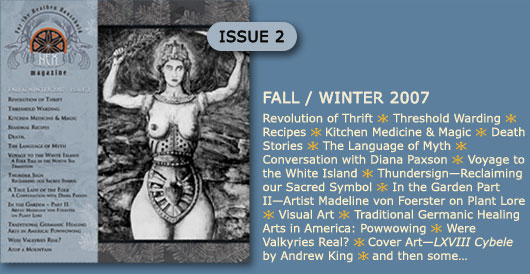
Hex Home Hex Harvest Hex Hails! Hex Folk Subscribe Submit! Hex Archive
<empty>
Fall 2007
Articles Artwork
Reviews
Poetry/Stories
Recipes


ARTICLES

REVOLUTION OF THRIFT
~ An Incitement from the Editors

“A wife that does not know how to keep house throws out more with [a] teaspoon than a man can bring in with a shovel.”

Obviously, we've seen some changes in the world around us since this German-American proverb was originally coined. Though the phrase may be outdated socially and politically, the lesson itself is not only still relevant, but also imperative. Its implications weigh heavily in our daily lives, and in the possibly limited days of our future generations.

What can we do about the materialistic runaway-train that drives many of the culturally and spiritually degrading views of modern society? For one, it is high time for us to let go of the destructive habits of consumerism. We must reclaim the thrifty mindset of yesterday in order to create a better tomorrow…and it all starts at home.

SMASH THE (CURRENT) STATE (OF MIND)!
One of the most genuine and lasting ways we can address wasteful living and spending is to attack our concepts of abundance and status.

The Evangelical Christian movement touts the promise that their god will bring you profit. Their reverends preach that god wants you to be a financial success—indeed, that your riches prove your righteousness to those around you. Although we don't dispute the idea that the divine wants us to prosper, it is possible to prosper in many ways other than monetarily. The well-known fable of The Midas Touch serves as a reminder of what truly matters. King Midas may have acquired gold, but it did not compare with the taste of ripe fruit or the pleasure of holding his beloved daughter to his breast.

In addition, the media, through screen, radio, and printed page, constantly calls us to define ourselves by what we consume—and to consume as much as we can. You can buy power, happiness, beauty, prestige, even love—or so the powers that be would have us believe. Walk down the aisles of any store. You will be surrounded by shelves upon shelves of food with no real nutritional value, items with no real use. (This is where the millions of dollars spent on marketing come in.) We are human animals and shaped by the stimuli in our environment, which urge us to feed our souls with things that we don't truly need.

But we do have wills, and the ability to make our own decisions. Don't buy that variety box of 8oz. individually bagged chips; don't buy that inferior set of plastic shelves; don't buy into the idea that money and possessions make us who we are…or that convenience is worth any price.

CHEAPSKATE
At times we may feel helpless to enact any real change in this modern age. But, by being that change you can reclaim your personal power. To live by the principles of our ancestors, who, yes, loved to feast, but wasted nothing, is a step in the right direction. Another definitive action toward real freedom and self-sufficiency is reducing your needs. Whittle them down. Get past the temporal wants to the core of what is necessary.

That's not to imply you should be stingy with yourself and family- quite the opposite. When you cease to squander your funds, you can afford to be generous! For living mindfully is not just about physical survival, it's also about learning to thrive without going into financial and spiritual debt. It's about freeing yourself from the slavery of material possessions.

Contrary to popular belief, being thrifty is quite different from being cheap. When you are thrifty, you are showing care and respect for the abundance the divine has bestowed. In contrast, when you are being cheap and miserly, you obstruct the monetary energy flow. You're telling life that you don't trust in the promise that you and yours will be cared for. This then becomes a self-fulfilling prophecy.

Be frugal with money, but not out of fear or a mindset of poverty. Be frugal with the knowledge that the less money you waste, the more you have for the things that are truly important to you. And sometimes the ‘truly important’ are not ‘things’ at all.

Maybe the most important thing to you is time. If you spend less money, (surprise!) you don't need to spend as much time earning money. Who wouldn't like more hours to put into their creative endeavors, or toward a cause they feel called to? Who wouldn't like more time with their loved ones? In many households, both parents feel the need to work outside the home full-time. However, once you pay for that second car, gas, insurance, childcare, etc., two forty-hour work weeks may not be financially justifiable. Making decisions based on our heart's desires becomes more feasible when we loose ourselves from the constraints of status quo mandates.

The balancing act of directing this energy we call money, without holding the reins too tightly, is a worthy endeavor that will pay for itself—not just in dollars, but also in peace of mind.

DEATH TO CONSUMERISM!
The invasive weeds of institutionalized consumerism have been allowed to smother what is truly useful and beautiful for far too long. The world garden, rampant with capitalist monoculture, is in desperate need of tending. By taking responsibility for our own existence, and deciding to be the conscious gardener of our own lives, we can weed out undesirable influences, and make room for positive growth.

Many of the things we can do to save household resources will also save natural resources, and lessen the strain we put on the earth and its population. Here are some of the most basic ways to enact the philosophy of frugality daily:

• REFUSE to buy disposable items (paper napkins, tissue, diapers...) and poorly-made, replaceable goods, whenever possible. Often ‘less expensive’ items are manufactured in third world sweat shops, which support globalization, slavery of the world's poor, and unemployment for the working class of developed nations. The real price of disposable culture is rising along with the level of our landfills.
• CHOOSE alternative modes of transportation (biking, walking, carpooling, public transportation, and car shares).
• REUSE. Discover the joy of second-hand clothing, books, furniture, and building materials—one man's trash…
• GROW your own groceries—start a Victory garden!* Eat at home. Skip the processed and refined foods; buy in bulk. Convenient foods generally have more packaging, cost more, and offer little in the way of nutritional value.
• RESIST fads, ‘sales,’ and other tactics that trick us into wasting money. The idea that one would be “Born to Shop” is not only ridiculous, but insulting.
• NOURISH your babies with breast milk. Besides being a far superior nutritional choice, it will save money in a myriad of ways: no need to buy formula; less money spent on treating sick babies, which turn into sick children, and sick adults.
• REVISE your definition of “quality time.” Take a walk. Play cards. Have a conversation. These activities are, literally and figuratively, priceless.
• REJECT Lysol and Chlorox, and all those other over-priced cleaners full of noxious fumes and chemicals. Baking soda, vinegar, and Borox cleaned our grandmothers' houses just fine.
• REDISCOVER the crafts and pastimes of our ancestors. Sewing, knitting, canning, and cooking are activities that connect us to previous generations, make us more self-sufficient, and save us money.

Seemingly minor decisions often have major effects on our pocket books, our souls, the environment, and even people we will never meet. Small choices make up the whole of our lives. We undertake journeys, one step at a time. Conscious decisions, although sometimes unpopular and often ridiculed, are never in vain.

- A. von Rautmann
* See our Spring 2008 issue for more about the history and lasting benefit of Victory gardens.

[TOP]

Threshold Warding
Juleigh Howard Hobson

Our folk have long recognized the inherent spirituality of all things. From the godly strength of thunder to the holiness of bodies of water, from the sacred festivals that marked the turning of the seasons to the recognition of, and respect for, the magical qualities of the trees and rocks; nothing of our world was taken for granted, and nothing of deeper worth was disregarded. Even something as seemingly mundane as a doorway, held and continues to hold, deep significance to our ancestors and in our own lives.

Our thresholds have a strong bearing, spiritually speaking, on our entire house. What we do at this entry to our InnanGarth, our private sanctuary, is of vital importance to the strength of both ourselves and our surroundings.

Warding our thresholds, like so many aspects of the Northern Way, is both straightforward and multilayered. It can be as simple as driving an iron nail into a door post and asking for Thor's protection, or it can be as complex as designing an entire dwelling upon the leylines that run across this world. Most ways, however, fall somewhere in between.

IRON FOR STRENGTH
One of the most common methods of warding a home entry is to hang an iron horseshoe above the doorway. This horseshoe represents Odin's horse Sleipnir, thus invoking his protection for all within the threshold. It also recalls the shape and strength of Uruz, the second rune, bringing those qualities to the quality of the door itself. Iron also has the special ability to keep evil spirits away.

A nail driven into the door frame will protect the home from fire and unwanted entry. Because it is shaped like the rune Isa it instills a stillness and peaceful quality into the space it protects, and because it is Thor who wields the mighty hammer, the nail symbolizes the power to ward and protect against chaos and giant problems.

RUNES FOR LUCK
Dagaz, the rune of opening and closing, when either painted, scratched, carved, or placed by a threshold has long been a traditional good luck icon for a doorway. It is usually painted blue and white. Other runes such as Ing, Gebo, and Othila are also effective protectors, although they are more likely to be painted on walls or placed in windows than in doorways. The patterns in old timber-framed buildings and in old lattices (windows as well as walls) are examples of these runic devices still extant today.

PLANTS FOR PROTECTION
Certain plants are very beneficial for spiritual protection of threshold. Honeysuckle placed above the doorway at Walpurgis lends protection; St. John's Wort placed above the doorway on the Summer Solstice not only protects but clears the home of negative and harmful energies.

Rowan, a tree connected with the protective properties of Thor, is a very good thing to have planted in/near a pathway that leads up to your front door. Not only does it protect, but like Thor, it deflects evil and malevolence from passing the threshold. If you cannot plant a Rowan tree, a small bundle of its twigs, tied with red cotton or wool thread and placed by your doorway, can offer much of the same protection. Likewise, oak (another tree connected with Thor) branches or acorns will stop ill will from crossing into your home.

Birch sticks (associated with the rune Berkana, and regenerative properties), placed by the doorway (preferably above it) will manifest positive energies while blocking negative ones.

Yarrow placed right in the doorway of a home has traditionally been used to bar entry to those who would disrupt the InnanGarth with malevolence. Because it can be somewhat hard to explain why you have long shaggy stems of yarrow sitting right there in your doorway, it is fine to snip dried yarrow into very tiny pieces, and scatter them across the threshold. This makes the herb unobtrusive, but still completely present and effective.

SYMBOLS FOR GUARDING
Hex signs, from the Pennsylvania Dutch tradition, are in reality old protective sigils of our folk. While there are many designs, the most appropriate ones for threshold warding incorporate a 6-pointed star or flower. This flower/star is a stylized version of the snowflake form of the rune Hagal, which brings continuity and preservation to the structure where it is placed (hail drives deep into the ground, saving the water it contains from running off when it thaws, thus hydrating the land and preserving in it the ability to grow another harvest).

An image of a rooster, which could represent Heimdall, on the hex sign brings watchful spiritual guardianship to your threshold.

Look, if you can, for a hex sign with a jagged circle as well as a 6-pointed flower or rooster. The jagged circle represents the power of the rune Thurisaz (the thorn) to drive away evil and disruptive powers from the home.

There is an old saying that a building with seven hex signs hung around it is fully and completely protected, but, if you cannot manage that, a threshold hex will bring plenty of luck and protection. And, importantly, it will also bring a daily pleasant reminder that our folkways are still very much alive and displayable, even if they are slightly hidden to most eyes.

The high and holy power of the Sunwheel, or Hook Cross / Fyrfos, (either scratched, painted, or hung somewhere on your threshold) will give great protection to your home from all unholy visitors and influences.

ON BEING DISCREET
Such threshold warding does not have to be visible to all. Magical symbols are often secretly placed or incorporated cunningly into more visible elements of design (think of the green man in all those mediaeval churches). A 6-spoked wheel placed near the doorway will bring the same beneficial effect as a Hag/hex sign. A series of jagged lines, which include repeated Sowilo ‘S’ runes, placed unobtrusively above the doorway, will ward the threshold as well as a more prominent Sunwheel will.

If you are completely unable to alter your threshold in any visible way, due to landlords, roommates, neighborhood associations, etc., trace the rune Dagaz or Othila with saliva on your door, using your right hand. This will work as an effective protective measure. Saliva has always been used by our folk for magical purposes, especially protective ones. When combined with runic magic, this method of doorway warding is quite strong...and utterly undetectable.

Every threshold is unique; every person who crosses a threshold has his own luck which affects both his life and the luck of the contents of the home. Your own instincts will guide you in choosing which symbols to use, and how to use them for your own self and home.

ON BOUNDARIES
There is great holiness in our thresholds. These places contain more than mere doorways that deter intruders with locks and peepholes. Our thresholds are gateways that mark a divide between this mundane world and the spiritual world, here and there, the ordinary and the sacred, our own selves and the rest of humanity. It is important that we are aware, each and every time we pass through them, of exactly what influences and energies are being allowed to pass as well. It does not benefit ourselves, our homes, or our folkway, to let negative and detrimental influences and energies enter our thresholds. Nurturing the ways that bring positive and helpful energies to these gateways benefits not only ourselves, but ultimately all kindred, all over Midgard.

The steadfast dedication of each of us to incorporating our ancient customs into our daily lives brings strength and vitality to our folkway and our folk. The reawakening of the Northern Way is done action by action, person by person…threshold by threshold.

I tell you, Loddfáfner, heed you the counsel:
Abuse no guest nor turn any away;
the poor do you well receive.

It takes a strong hinge to keep the door open to all;
yet give of your alms lest one wish you ill.

(Havamal 134; 135, Translation by E.B. Titchenell)

Hail the Folkways!
Hail the Folk!
Hail the Reawakening!

In a slightly altered form, this article has previously appeared in the Asatru Folk Assembly Voice.

Source Literature and Further Reading:

Chisholm, James. True Hearth: A Practical Guide To Traditional Householding. Texas: Runa Raven Press, 1993

Coulter, James Hjuka. Germanic Heathenry, A Practical Guide. New Jersey: First Books, 2003

Davidson, Hilda Ellis. The Lost Beliefs of Northern Europe. New York: Barnes and Noble (through arrangement with Routledge), 1993

Flowers, Stephen. The Galdrabok: An Icelandic Grimoire. York Beach: Weiser, 1989

Guerber, H. A. The Norsemen (Myths and Legends Series). New York: Avenel, 1986

Pennick, Nigel. Practical Magic in the Northern Tradition. Leicestershire: Thoth, 1989

Thorsson, Edred. Northern Magic. St. Paul: Llewellyn, 2002

Thorsson, Edred. A Book of Troth. (Runa Raven Yrmin Edition) Texas: Runa Raven, 2003

[TOP]

Kitchen Medicine & Magic ~ Roots
Teresa Luedke

There are two lasting bequests we can give our children:
one is roots, the other is wings.


Hodding Carter, Jr.

In each issue this column will explore commonplace medicinal/magical foods and tools in our 21st-century kitchen; the very same foods and tools found at Heathen hearths more than a millennium ago. By investigating European/Heathen history, Norse sagas, and various other folklore, this column will seek to rediscover some of the Heathen ancestral knowledge and power in our own kitchens. Armed with a better understanding of these foods and tools, the reader can perhaps deepen their spiritual connection as well as enhance the ritual workings of Heathenry as a personal and/or family folk religion.

In the first issue of Hex, the elements of fire and ice were explored, with the hope of bringing the magic of such elements back into the high status and acknowledgement they deserve. This second issue will attempt to uncover some of the roots buried in our Heathen Kitchens, for use in Medicine and Magic…at least the roots of underground vegetables. Roots were certainly well known kitchen ingredients before the age of fast foods and frozen dinners, but as Odin will tell you…“...no man knows from where...the roots run.”1

ROOTS
Many people have lost touch with root vegetables, just as they have lost touch with their family roots. This is an unfortunate change in the way we look at foods, because besides tasting good, roots usually have a relatively long shelf life that does not require electricity or complicated pressure cookers. They are also highly nutritious and can serve as both food and medicine for men and animals. Many roots were known in the Heathen kitchen. Some were native to Europe and some found their way to the Germanic peoples from other places. Often local and non-local roots were improved or changed into new varieties. In this Fall issue of Hex, we will explore a little of the history and magic of one of the world's most well known roots, one that is native to Europe but also changed and improved—the carrot. Early Celtic literature referred to this root vegetable as the “Honey Underground!” In fact, carrot is a Celtic word, and means ‘red of color.’2

While many people may automatically associate roots with root vegetables, those who have invested any time in Heathen lore would also think of the many stories and sagas from history and lore that involve roots. First and foremost, the roots of the world-tree Yggdrasil come to mind. Within this tree’s roots there is much activity. The mysterious maidens known as “the Norns” live there and tend to the tree and the well of wyrd. It is where Mimir's Well holds Mimir's still living head, and where Heimdall’s Horn, and Odin's eye are said to be located; and where the dangerous Nidhogg and other serpents live. Then of course, many Heathen folk tend to look closely at their family trees seeking their own roots. The word ‘root’ comes to the English language from the PIE wrd- which is cognate with the OE wyrt or ‘wort.’ The meaning was originally ‘underground part of a plant.’3 In the European kitchen, roots have been valuable sources of food and medicine for countless generations. Many of the roots now available in the produce section of the grocery store are the result of European ingenuity.

Root vegetables contain seemingly magical ingredients modern science is really just beginning to understand. But the nutritional and medicinal uses of these properties were discovered many generations before the mysteries contained within them began to come to light. Some of these ingredients are vitamins and minerals, but also antioxidants, phyto-estrogens, flavonoids, carotenes, bitter digestive stimulants, phyto-nutrients, soluble and insoluble fibers, and other seemingly magical substances yet to be named or discovered. These magical ingredients could be considered the magan of the food. Magan [OHG mag-an or OE meagan] is an old term meaning “luck, strength, power, or spiritual energy.”4 The magan of these ingredients is at work in foods when they affect our health. This can be seen in foods like carrots which are credited with the ‘power’ to help to promote and protect eye health; or Dandelion's ‘strength’ as a diuretic when ingested; or the stomach-soothing ‘spiritual energy’ of ginger root to treat motion sickness.

CARROT ROOTS
The carrot, Latin designation Daucus carota, is a member of the Umbelliferae family of plants (also known as the Apiaceae family) and is among more than 3,000 species of this generally aromatic family of plants. Fossilized pollen from the umbel family has been dated at more that 50 million years old (the Eocene period).5 Archaeological evidence of carrot seeds in probable use by Indo-Europeans has been found in pre-historic Swiss lake dwellings.6 Other native European umbels include (but are not limited to) such useful plants as celery, parsley, dill, coriander, fennel, and parsnip. The Umbelliferae families generally produce aromatic, hollow-stemmed plants with large, whitish, umbrella shaped flowers. These flowers appear to be a single large flower, but a closer look reveals they are actually composed of many hollow-stemmed umbel-shaped flowers in a larger umbel-like formation. Wild carrot is a biennial, and thus does not flower until the second year of growth. Its flowers then contain about 500 individual umbels in each larger compound flower, with one reddish flower at its center—this reddish flower is one of the identification points of a wild carrot. The wild carrot, a common summer wildflower on the American and European continents, found along roadsides and in fields, is called ‘Queen Anne's Lace,’ and shares the same species as its domestic cousin.

Wild carrot look-alikes also grow as wildflowers, but they are deadly. The poisonous Water Hemlock Circuta maculata, Poison Hemlock Conim maculatum, and the poisonous Fool's Parsley Aethusa cynapium, are mentioned as ingredients in “Flying Ointments”7 during the middle ages. Perhaps harvested in the manner Shakespeare mentions during the making of the deadly "Witches' Brew" from Macbeth—“Root of the Hemlock, digged i’th’ dark.”8 The Greek physician Socrates will forever be associated with poison Hemlock after he chose to ingest it to carry out his death sentence in 399 BCE. The resemblance between the umbel-shaped wild flowers is too close to allow them to be safely wild-crafted in a casual way, and all of them now grow wild across the same habitats. Do not wild-craft carrots! Besides, wild carrots are not like the improved version we use today, the roots being many branched and smaller—so, leave it to the experts to distinguish between these wild look-alikes. In fact, your local County Agent may be of assistance since most counties wish to eradicate these invasive highly poisonous plants. The poison in these plants can remain active for 3 years or more. Do not dispose of them in compost piles or burn them, but treat them as toxic waste! Instead purchase organic carrots. They're relatively inexpensive once you think about the heavy pesticides used in conventional carrot production. Better yet, try your hand at growing them yourself!

Carrots have a complicated history in the old world. Their use was reported by the Greeks and Romans, but cultivation was not well known in Europe until the Middle Ages. The way carrot plants can resemble other dangerous plants, leads me to speculate that this could be one of the contributing factors to the relatively late cultivation of carrots as a food crop in some areas. Without images of the sometimes subtle differences between these wild plants, at all stages of growth, identifying and distinguishing them can be difficult today, and nearly impossible to all but experts. I have seen this physical similarity and had to resort to printed media for the complicated identification. Perhaps such knowledge may have been something known to only a few Leechcraft practitioners—limiting its use to the magical medicinal arena. See more about Leechcraft in the side bar.

Much of the European folklore before the 15th-century refers to the wild carrot and the wild parsnip Pastinaca sativa, more or less together. The carrot root in OE is enlisc moru or ‘English Root’ and its cousin the Parsnip was called wylisc moru or ‘Welsh Root.’ The OE word more (moru) still survives in some dialects, and refers to any root vegetable such as a parsnip or carrot. Feldmora and wild more were said to grow “in sandy places and on mounds.” Perhaps these were burial mounds, where the disturbed soil would be better suited to root growth.9 The folk name Queen Anne’s Lace, reportedly refers to the small, reddish umbel flower in the center of the compound flower, as representing a drop of blood from a needle prick of Queen Anne’s finger while lace making. The synonyms ‘Bird's Nest’ and ‘Bee's Nest’ seem to reference the way the lacy umbel flowers curl up like a small nest when they dry.

These wild mores contained various pigments ranging from purple to black, white, yellow, and green—colors that are usually evidence of active constituents that can promote health. It’s believed that the cultivation of the larger, purple variety of carrot that was known in Arab-occupied Spain around the 10th-century, and later reached the rest of Europe and Asia, was introduced by Afghanistan. From this purple cultivated carrot, an occasional mutation would produce a yellow carrot containing no anthocyanin (purple-colored) pigment. These mutations most likely generated the ancestor of the modern carrot and were perhaps selected because purple or black foods may not have been as appealing at the table as yellow.

CARROTS IN THE KITCHEN
The relatively modern orange carrot was not developed until the 1500s, as a tribute to the princely dynasty, The House of Orange, in Holland. The Dutch exploited the carotene, responsible for the orange color of the roots we know today. This orange color indicates they are one of the best sources of pro-vitamin A and beta-carotene available in our food. Uncooked orange carrots contain about 30 calories in a 1/4 pound, over 8,000 mcg of Carotenes, a very good serving (2.4 grams) of fiber, 6 mg of vitamin C, and 0.6 mg of vitamin E. Count the carrots in the bag next time and see how many are in a 1 lb/16 oz bag. For example, 8 carrots would equal a 2 oz. weight for each.

Findings reported in 1993, from an eight-year controlled study of 87,000 nurses, showed that eating just 5 large carrots a week lowered the risk of stroke by 68%.10 A 1979 Scottish medical trial had healthy volunteers eating 7 ounces (200 grams or 1/2 pound) of raw carrots a day for 3 weeks. They reduced their blood cholesterol levels by 11%—about the same as modern ‘Staten’ drugs can achieve.11 The cholesterol rose to previous levels when the carrots were removed from the diet.12 The nutrients in carrots have more bio-availability when cooked.13 So, while there is nothing wrong with eating them raw, you may wish to introduce more steamed or roasted carrots into your diet as well.

Much of the folklore surrounding the wild mores of Europe includes medical uses such as treatments for coughs and lung ailments, both internally and externally as poultices; as an ingredient in antiseptic wound salves (see formula in sidebar) and bite treatments, and as skin lightening masks (see formula in sidebar). Feldmoran, or ‘field more,’14 which in this case are parsnip seeds, were used by a king “both wise and skilled in healing,” in conjunction with many other seeds, ground and used in powder form, “as a good morning drink against all infirmities which stir up a man's body, within and without.”15 They are very useful to a woman’s body “within and without” as well. Carrot seeds have been reportedly used by women in Rajastan, India as a contraceptive,16 but carrot roots were used to promote lust and pregnancy,17 and to regulate menstruation.18 Once pregnant, a drink based on wild more can be used to ease birth. And a raw carrot salad can be used as a fibrous medium to clean the intestinal tract!19 Later when the mother’s nipples are chapped from nursing, raw or cooked carrots can be used as a poultice for pain relief and to promote healing.20 Raw carrot, even in small amounts, has been shown to kill listeria and other food poisoning organisms.21 Anglo-Saxons used carrots as an ingredient in a medicinal drink “against the devil and insanity.”22 Speaking of devilish insanity, in Germany, “a spirit [liquor] is distilled from the Carrot, which yields more spirit than the potato. The refuse after making the spirit is good for feeding pigs.” 23 And last but not least, large amounts of raw grated carrots, mixed with lots of onion and garlic and eaten in bulk, scour the system and make an excellent vermifuge, helping to remove worms from the intestines.24

Recently carrots and the antioxidants they contain have begun to play a major role in the anti-aging and skin care industry. The essential oil of carrots is often included in formulations designed to lighten skin color. Do not use undiluted carrot essential oil directly on the skin! Use the Anti-aging poultice in the side bar to help lighten darkened skin pigment (melanin) and perhaps nourish stressed skin cells.

NOTE:
Recently some plant experts have speculated that the wild carrot currently called Queen Anne's Lace could be a ‘new’ plant, the descendant of escaped cultivated carrots and not actually the ancestor of the modern carrot. Attempts to produce a root worth harvesting from Queen Anne’s Lace have not been very successful.25 So the carrot's origins remain partially hidden, buried by time.

ROOTING IN THE EARTH
Growing carrots and other root vegetables is not hard at all. Be sure to deeply loosen the soil for roots to achieve the best shape and maximum growth. Wild carrots and parsnips were noted as growing “in sandy places and [assumed grave] mounds,”26 in old world Europe, perhaps because the soil had been loosened. Most folklore advises to plant root crops during the dark time of the moon to ensure large tasty roots, because roots grow in the dark earth. Carrots grown for food are best when planted and harvested during the fall, winter, and spring seasons; the summer months generally produce flower heads, and at this time the roots are tougher and less pallatable. Plant small seed beds (following the directions on the seed package), every few weeks for a contiuous harvest, or plant one large crop in the fall to keep through winter and another in the early spring to last until summer. Plant the tiny seeds directly into soil with a pH range of 6 to 6.5. Thin carrot seedlings by pulling while still very small, to achieve about 3 inches space between each plant, later thinning again by taking out every other root, to ensure enough room for the roots to grow without crowding. All the roots removed through thinning are still edible, consider them baby 'gourmet' carrots. Water, weed, and feed regularly to promote quick root growth and to also help ensure sweeter carrots and  all other root vegetables as well. Carrots can be attacked by carrot root flies and flea beetles, though I have never found them to be much of a problem. Keep these at bay with a physical barrier like floating row covers of spun polyester, thereby avoiding pesticide use; since carrots do not need to be pollinated they can be covered before they even sprout. Harvest can start at any time after carrots are big enough to eat, but generally the main harvest is about 65 days after they germinate. With continuous plantings about every 2 to 3 weeks throughout the spring, fall, and winter when the ground isn't frozen, it's possible to have fresh carrots growing nearly all year.

Johnny’s Selected Seeds, a company specializing in saving old-fashioned seed varieties, carries 24 varieties of carrot seeds! The categories include early, main-crop, and storage/specialty types. They come in various colors from the traditional orange to purple, white, or even a rainbow mix, and shapes include the well-known long carrot, other shorter varieties, and even round radish-like varieties. The Texas A&M Vegetable Improvement Center has developed and introduced into commercial use a new purple-skinned, orange-fleshed carrot, the BetaSweet or Maroon Carrot, which contains even stronger concentrations of the substances that prevent cancer.

Mike and Nancy Bubel in their classic food preservation book Root Cellaring, note that “the reliable carrot is the backbone of any food storage plan,”27 and can be stored right in the garden row during the winter if mulched and protected from animals. Or they can be dug up, the dirt brushed off, and the green leafy tops snipped away just above where they join the carrot root. Store in boxes or baskets. Carrots can touch in the layer, but place straw, sand, newspaper, or another medium between each separate layer. Keep temperatures around 32–40 degrees with a 90–95% relative humidity.

FINAL NOTE
Not surprisingly, there is much more to this story! I would advise anyone who wants to learn more about this root to check out the carrot museum online.28 The amount of information about carrots is mind boggling—there is even an article that talks about carrots being used for lasers in space!29

Be sure to include carrots and parsnips in your next feast. On second thought, these masters of Kitchen Medicine and Magic should be included in nearly every meal and snack! Eat them raw, or cook them—juice, grate, cube, slice, or chop them—boil, roast, or stir fry them—no matter how you eat them—eat them! Hail the carrot!

Read a recipe for Carrot Cake, or Cabbage Slaw. For more recipes and root lore, read the Fall Issue of HEX magazine. Teresa would love to hear from you, so send in your comments and questions to this HEX address:
hearthfire@hexmagazine.com

Endnotes
1. Carolyne Larrington, The Poetic Edda: A New Translation (Oxford: Oxford World's Classics, 1999) 34.
2. www.carrotmuseum.co.uk
3. www.etymonline.com
4. James Hjuka Coulter, Germanic Heathenry A Practical Guide (1st Books, 2003) 228.
5. www.carrotmuseum.co.uk
6. www.carrotmuseum.co.uk
7. Claudia Muller-Ebeling, Christian Ratsch and Wolf-Dieter Storl, Witchcraft Medicine, Healing Arts, Shamanic Practices and Forbidden Plants English translation (Rochester: Inner Traditions, 2003) 51.
8. Muller-Ebeling 142.
9. Stephen Pollington, Leechcraft, Early English Charms, Plant Lore, and Healing (Norfolk: Anglo-Saxon Books, 2003) 147.
10. www.drnorthrup.com
11. www.drnorthrup.com/news/aspirin.php
12. Miriam Polunin, Healing Foods: A Practical Guide to Key Foods for Good Health (Singapore: DK Publishing, 1997) 33.
13. Steven Pratt, M.D., Steven and Kathy Matthews, Super Foods: Fourteen Foods That Will Change Your Life (New York: Harper, 2005) 106.
14. Pollington 240.
15. Pollington 241.
16. www.etymonline.com
17. Cunningham's Encyclopedia of Magical Herbs (St. Paul: Llewellyn Publications, 1999) 68.
18. Dian Dincin Buchman, Herbal Medicine: The Natural Way to Get and Stay Well (New York:Wings Books, 1979) 165.
19. Pollington 325.
20. Buchman 171.
21. Polunin 33.
22. www.etymonline.com
23. www.botanical.com/botanical/mgmh/c/carrot24.html
24. Buchman 181.
25. Jack Sanders, The Secret of Wildflowers. (Guilford: The Lyons Press, 2003) 186.
26. Pollington 147
27. Mike and Nancy Bubel, Root Cellaring (Emmaus: Rodale Press, 1979) 61.
28. www.carrotmuseum.co.uk
29. www.carrotmuseum.co.uk
30. www.meadhall.homestead.com/Sigdrifa.html
31. László A. Magyar, "Digitus Medicinalis — the Etymology of the Name," Actes du Congr. Intern. d'Hist. de Med. XXXII (1990): 175-179.
32. Pollington 405.
33. Buchman 82.
34. Marie Rodway, A Wiccan Herbal: Healing Secrets of Natural Magic (London: Quantum, 1997) page 37.

Book Hoard and References
Forbidden Plants. Rochester: Inner Traditions, 2003 (English translation)
Vaughan; J. G. & C. A. Geissler, The New Oxford Book of Food Plants. (Oxford, Oxford University Press, 1998)
http://en.wikipedia.org/wiki/Ring_finger

[TOP]

Death.
Death stories by four people, Amie, Julius, Arrowyn, and Gerhard.

Read more in the Fall Issue of HEX magazine.

[TOP]

The Language of Myth
Antonius Block

To say that ‘Indo-European’ is a term many Heathens have come across at least once or twice would be a grand understatement. Unfortunately there is not, to my knowledge, a single book dealing with this subject currently available on the market written specifically for a Heathen readership and based on a sound understanding of the topic. While unquestionably relevant to Heathenism, the subject of comparative Indo-European language, culture, and myth has received cursory and often inexpert attention from Heathen authors. The Language of Myth is my attempt to correct that—at least in part. It is a recurring column intended to highlight the relationships and evolution of various Heathen mythic themes and cultural ideas, as well as the vocabulary used to describe them. None of the ideas discussed in this column are intended to be original or innovative. My purpose here is to provide a summary of information, on selected topics, compiled from various sources. I will also supply a list of works that interested readers may be inclined to seek out.

Read more in the Fall Issue of HEX magazine.

[TOP]

Thunder Sign
Reclaiming our Sacred Symbol
ManWoman

Think of the most sacred thing in your life. Think of the most precious thing in your life. And then, put the swastika into that place. Put the swastika into your heart. Put the swastika on your altar. Put the swastika on the image you use to represent god, love, peace, or the cosmos. Put the swastika on the thing that makes you happy. You will begin to see what the swastika has meant to humans over this entire planet for all of our human history. For these places are exactly the places it occupied for thousands of years until the Second World War.

For more amazing, worldwide swastika history illustrated by 400 rare photos, see my book Gentle Swastika: Reclaiming the Innocence. You can also go to my Friends of the Swastika website at www.manwoman.biz.

Note from the Editors:
Now that you are aware, look for swastikas all around you—in textiles, in architecture, all over our cities, in the logos of companies, in nature. They are everywhere—a powerful symbol in our collective consciousness. It is also part of our mission to reclaim the swastika and we are starting our own collection of swastika photos. Please send any photos or artwork with an explanation to: swastika@hexmagazine.com. Look for it @ www.hexmagazine.com/swastika.htm

Note from Markus Wolff:
For an in-depth overview of this universal symbol, please also seek out Thomas Wilson’s 1897 landmark study The Swastika, available as a PDF file from the excellent Northvegr website. Of course, this book is somewhat dated and it is a sad state of affairs that no thorough scientific study of this symbol has been undertaken in the English language. [http://www.northvegr.org/lore/pdf.php]

Read more in the Fall Issue of HEX magazine.

[TOP]

A True Lady of the Folk
Conversation with Diana Paxson conducted by A von Rautmann

To those already immersed in neo-Heathen culture, Diana L. Paxson hardly needs an introduction. To those just dipping their toes in, we are pleased to bring you a leading woman in the traditional Pagan movement. From actively practicing/teaching the shamanic path of our ancestors and compiling a comprehensive guide to the runes, to writing novels based on myths of Northern Europe, to openly addressing modern topics such as gender, race, and sexual orientation, Mrs. Paxson is: A TRUE LADY OF THE FOLK.

HEX: It seems reasonable to start at the beginning. How would you describe your experiences of, and your contribution to, the earlier days of the modern pagan revival?

PAXSON: I grew up reading mythology, sitting out to commune with the moon and finding a lot of spiritual nourishment in nature, and envying Native Americans and others with a living ritual tradition, but my first introduction to actual polytheistic practice did not happen until I was in my twenties, in a ceremonial lodge led by Marion Zimmer Bradley and her husband. It was called the Aquarian Order of the Restoration (AOR) and was based on the works of Dion Fortune. At that time, the books by people who came out of the Order of the Golden Dawn tradition, such as Fortune, A.E. Waite, and others were just about the only magical works available. Marion insisted that each member take charge of one of the seasonal ceremonies, which is how I discovered that I could write rituals.

A few years later, in 1978, a young woman in the group asked me to write a coming-of-age rite for her. I thought that working with the idea of the triple goddess might be interesting, and asked a bunch of women from the community to participate. In the ritual we all made a powerful connection with Goddess-energy, of a kind that even those who were involved in Wiccan groups had not encountered before, and decided to keep working together. That group became Darkmoon circle, which is still meeting regularly today. Throughout the early 80s Marion and I went to every workshop and lecture we could find, and brought back what we learned to the group. I have sought to learn and share spiritual skills and knowledge ever since. Some of us found we were being called to act as clergy, so we started a clergy training program. There was an exciting spirit of discovery in the air.

At that time most of the people who were interested in the Norse gods practiced solo, although Steve McNallen actually lived in Berkeley for a while and started holding meetings of the Asatru Free Alliance here. My brother-in-law used to attend, and said it was quite amusing when the Old Norwegians ran into the neo-Nazis. The AFA had its ups and downs, but I remained friendly with Prudence Priest and kept in touch with what was going on with proto-Heathenry. I got closer to the Norse gods when I wrote a book called Brisingamen (1983), which apparently all the other early Heathens read, so when I finally did encounter them they all knew who I was.

Darkmoon hived off a number of other groups, which eventually allied as the Fellowship of the Spiral Path. After working with Kabbalah for several years, I started exploring neo-shamanism as a balance. I found the techniques useful, but I had done enough work with Native Americans (writing educational materials) to wish I had a tribal tradition of my own. In 1987 I attended one of Harner's shamanic workshops, and when asked to journey and seek a teacher in human form, quite unexpectedly I encountered Odin. When he asked if I was serious about learning Norse shamanic techniques I said yes. Little did I know that would be the beginning of an enduring relationship. To get started, I gathered some of the very talented people in our community together for a Rune Class (the basis for my book, Taking Up the Runes), and from there began to figure out how to do oracular seidh. The class eventually developed into Hrafnar kindred.

In 1991 I was First Officer of the Covenant of the Goddess (another educational experience). At the National Meeting I met Phil Nearing and Bill Bainbridge, who were members of the newly formed Asatru Alliance and the Troth, and wanted to make contact with other kinds of pagans. They also had some very good mead, which after presiding over the Grand Council all day I really needed. They persuaded me that Heathens were not all racists, and encouraged me to subscribe to Idunna, the Troth's journal.

At that point Prudence Priest had become Steerswoman of the Troth, and started holding the Troth's annual meeting in the Bay Area. I brought my kindred and we performed seidh at Trothmoot, the first time anyone in Heathenry had ever seen anything of the kind. Since then I have taught our approach to seidh in many workshops, and gotten the idea started in general. From that time to the present, my focus has moved steadily from eclectic Paganism to Heathen practice, although old oaths and relationships keep me connected to the general Pagan community.

HEX: As HEX is “for the Heathen Household,” I think our readers would find an explanation of your household, Greyhaven, interesting.

PAXSON: In 1968, when I got married, no one in our community had any money, and it was common to share housing. So my husband (writer Jon DeCles) and I formed a family with his adopted brother, Paul Edwin Zimmer (brother of Marion Zimmer Bradley), and his wife, and his mother. In 1971 we jointly bought a big old house in Berkeley that we named Greyhaven, in which we raised our children. Since then it has sheltered the extended family and assorted friends. Today, it is still a multi-generational household, shared with my son Ian Grey and his wife and three children. In many ways, our situation is like the kind of extended, family-based household one sees in the sagas.

HEX: Even the more mundane, daily aspects of seasonal change hold magical qualities. What are some of your favorite parts of these darker months of the year? Are there any traditions that you feel especially drawn to?

PAXSON: Since well before I was a practicing Heathen, our family has had its own traditional Yule celebration. On the eve of the Winter Solstice, we gather before the hearth, read a seasonal story, and light the Yule log. We then make offerings of gingerbread animals to the gods and goddesses, which we hang on the Yule tree. By then, the feast should be ready. I bring in the pork roast, garlanded with bay and rosemary, and we all sit down. After dinner, we finish decorating the tree. All this is accompanied by appropriate songs, which you can find in the Troth's Book of Yuletide Carols.

We celebrate Christmas as a secular family holiday, but the children do put out milk and cookies for the Jul-tomte the night before.

HEX: With all the reading material available on runes, their lore, and divination, what moved you to write Taking Up the Runes?

PAXSON: There seemed to be a need for a book that would give people the essence of the evolving tradition in one volume. Unfortunately, many of the excellent rune books to which I refer in the text are out of print. I encourage people to buy them if they can find and afford them.

The other reason is that I have found no other book that takes this holistic approach to studying the runes. Some people do very well by simply reading and thinking about the material, but others need hands-on, real-world activities to internalize their meaning. The ritual work will also help embed the material in the unconscious.

HEX: Freya Aswynn defines seidr (pronounced ‘sayth,’ where the ‘th’ is voiced) as: “Literally ‘seething,’” Seidr is the name of a variety of magical and shamanic practices involving sorcery, divination, and “soul journeys.” (Leaves of Yggdrasil, Llewellyn Publications, 1994) What is your approach to seidh, also seidr? How does it relate to what we know of the seidh of our ancestors? How much is based on intuition?

PAXSON: In the lore, the term ‘Seidh’ (or ‘seith’) is used to cover a variety of magical activities, all of which involve altered consciousness or trance. It may or may not mean “seethe”—the scholars disagree on that one. Steven Glosecki, for instance, derives it from ‘sittan,’ which would make it cognate to ‘séance.’ However, stirring a cauldron while cooking up magic would certainly qualify as seidh-work.

A longer list can be derived from the description of Odin's seith skills in Heimskringla (Ynglingasaga VII). The author, as a Christian, presents them as negative, but they include: predicting the future, causing harm to come to men (and presumably also bringing them luck), causing soul loss and illness (or good health), taking or giving wit and power, astral journeying in animal form, using spells to extinguish fires, calm the sea, and call the winds.

In the sagas, however, most of the episodes referred to as seidh refer to an oracular ritual. The best example is found in the Saga of Erik the Red (ch. 4), in which a Völva (seeress), in Greenland, prophesies. The Eddic poems in which Odin seeks information from the Völva in the underworld feature a pattern of question and answer that may be based on seidh practice.

In our private work we use a number of seidh skills, but publically I am most associated with the oracular practice, which incorporates as many features from the saga and edda material as possible. The seidhmadhr (male) or seidhkona (female) sits on a raised seat and is put into trance with a sacred song. The questioning includes the formulaic words from the eddas. To this I added other songs, invocations, and a pathworking to Hel, mainly to provide a setting that will move the people attending into the Norse sector of the collective unconscious. I also use a drum—its authenticity can be debated, but it is definitely effective. So most of the ritual is definitely based on the lore. The way those elements are combined and applied is what comes from intuition.

For a more extensive discussion of my approach to seidh, see my website: www.seidh.org, especially the article, “The Return of the Völva.”

HEX: I would like you to address the topic of genetics as it relates to spirituality. You touch on it in the introduction of your book Taking Up the Runes (Red Wheel/Weiser, LLC, 2005): “The runes are an expression of the spirituality of Northern Europe, but the culture in which they are currently flowering is diverse and pluralistic. Just as people of all ethnic origins may be attracted to Native American spirituality or the worship of the orishas, individuals of many backgrounds are becoming fascinated by the runes. There has been a great deal of discussion about the value of genetic links in accessing ethnic spiritual systems. Many people find that the magic of their own ancestors is easier to learn. I myself approach the Northern tradition with more confidence because I know that my foremothers did the same. However,…there are many individuals who have a natural affinity for the religious practices of cultures with with they have no genetic connection. The gods look at the colors of our spirits, not our skins. Today, spiritual traditions are becoming as exportable as ethnic foods.”

I would like to contrast this to a Thorsson quote:
“Modern people seem to think that they can choose to become something which they are not in reality, e.g., an Amerindian shaman, or a Kabbalistic mystic. But one can never truly become that except in one's own imagination (and perhaps in the imaginations of others). In truth, we can only, to paraphrase Fichte, become who we are. Within that realm of possibilities is an infinite number of directions, but the tradition is a fixed one…One must simply ask oneself: ‘Of what can I be a 'first class' exemplar?’ Can I be a first class Amerindian shaman?? No, an Amerindian can be that. Can I be a first class Kabbalist? No, an orthodox Jew can be that. The positive answer to this question can be many things. But in one's own heart, if the honesty of that answer is complete, the authentic awakening will be unmistakable and and irrevocable in life.” ~Stephen Edred Flowers (2nd issue of TYR, Dominion, 2004)

You use Edred Thorsson (Dr. Stephen Flowers) books as a main reference for the study of runes in Taking Up the Runes so you obviously think highly of his research, insights and opinions. What do you think causes this split in perspective among those who practice our tradition?

PAXSON: I think the problem here is that Thorsson, like many others, is identifying cultural with genetic heritage. Someone who is the product of a given culture will certainly have a head start on mastering its spiritual traditions, whereas someone who is new to the culture will find it more difficult, no matter what his or her ancestry may be. Thus, Native Americans who were taken from their parents as children and raised in the White Man's world have the same problems learning how to fit into tribal culture as someone of English ancestry would, although their bloodline may make it easier for the tribe to accept them. Similarly, a ‘secular’ Jew has no inherent advantage in learning Kabbalah. In the days when I was working with that system, a number of Jews joined my classes in order to learn something about that part of their heritage.

On the other hand, tribal cultures will sometimes adopt people of other ethnic groups who marry into the tribe or otherwise seem to have a natural affinity for their ways. A “first-class Amerindian shaman” is someone who has been trained by an authentic tribal shaman, and who is accepted by the tribe, whatever his or her ethnicity. My friend Elisheva, who comes from Israel, can teach anyone to interpret the Hebrew lots as simple concepts, in the same way we read the runes. But to interpret them as words and reach the deeper meanings, one has to be fluent in Hebrew and brought up in the culture.

Thus, although those who are genetically kin to the culture whose spiritual traditions they are practicing may have more confidence in their right to do so, their success will depend on how embedded they are in the culture.

Those of us who practice the Reconstructionist religions have a somewhat different problem. Our traditions have been patched together from bits and pieces of lore, illuminated by personal inspiration. Where a folk tradition survives, as in rural Ireland, it has been so overlaid with Christianity that it can be hard to identify the real Pagan survivals. All of us, whatever our genetic background, have to steep ourselves in the lore in order to recreate the cultural background that a tribal person grows up understanding. But no matter how much we might wish it, we do not live in a traditional Heathen society. Even if we had access to a complete manual on Viking Age religious practice, we would have to adapt it to meet modern needs (Not even the most dedicated Heathen is likely to be willing to splash sacrificial blood all over his living room walls).

Today, people seem to come to Heathenism because they have developed a strong relationship with one of the gods or goddesses, and/or because the Heathen worldview fits their personality and lifestyle. Neither of these factors is dependent on heredity. The only advantage that being half-German has given me is that my authenticity as a Heathen priestess is accepted more easily when I do interfaith work with tribal people. However, we have a deep need for identity, and claiming an inherited right to a religious tradition gives us a sense of entitlement and authenticity. I think this is why many people who are trying to recreate a tradition are using heredity as a mark of spiritual identity.

HEX: Lastly, what new Heathen-related projects are you currently turning your attentions to?

PAXSON: Many of you have probably heard that the Wiccans finally got the Veterans' Administration to add the pentacle to the list of symbols approved for grave markers. This got me thinking once more about the need for inspirational materials for Heathens in the military. At Trothmoot this year I took oath to put together a devotional booklet for Heathens in the military. I have already written a ritual to bless someone about to be deployed, and am working on one to reintegrate someone returning from active duty. We are also working on informational materials for military chaplains and a book that covers the religious rights of military Pagans, how to set up a faith-group on base, and the like.

I have also been working on protecting religious rights in general by invoking the Founding Fathers as alfar—ancestor spirits—to help us protect the rights they fought for. I had the privilege of leading a ritual for this purpose at the Pagan Religious Rights Rally held across the street from the White House on the 4th of July this year. For more information on this, see www.freedomfathers.org

My other great concern is exploring those elements in Heathen theology and lore that relate to the current challenge of climate change. I use the ‘Gjallarhorn Alliance’ for those who hope that if Heimdall blows his horn softly now to warn us to change the way we treat the environment, he won't have to blow it in earnest in a few years to announce the end of the ecosystem in which we, our civilization, and our gods evolved.

The Spring 2008 issue of HEX will include a reprint of Diana's article Sex, Status, and Seidh, which originally appeared in the journal Idunna.

For a list of upcoming seidh workshops or for information on bringing one to your area, go to: www.seidh.org

[TOP]

In the Garden ~ Part II
Madeline von Foerster—an artist's lore of plants

What plants contribute to our world is something beyond measure, or
even description. It is common to view plants as nonentities separate
and less important than ourselves, without comprehending that their
existence is the keystone of our own. Their minute alchemy transforms
inorganic matter into something we can ingest, transforms carbon dioxide into something we can inhale. In the web of life on Earth, plants provide the most significant strands.

My painting, In the Garden, is my love-letter to Kingdom Plantae. Surrounding us are plants with myriad and marvelous properties, each unique species able to fulfill some different exigency of our bodies or spirits. They feed us, shelter us, clothe us, heal us, intoxicate us, and delight us with their beauty and fragrance. Abstractly, they decorate our temples and bodies, inspire our myths, and give us comfort with their very beings.

The style of In the Garden is inspired by the tapestries of medieval Europe, a period in which the divide between medicine, botany, and art did not yet so clearly exist. Looking at these tapestries, so richly embellished with botanical images, one is amazed at how carefully the plants are depicted—individual species are readily discernible. An astounding amount of toil is required for such detailed weaving. Becauseof this source of inspiration, and my interest in the medieval era in general, I thought it would be interesting to explain what some of the plants I selected for the painting meant—their symbolism, usage, folklore, and history. With one or two exceptions, the plants in the painting were familiar to medieval Europeans, and can be easily found in art from that era. This article will be continued in the Fall. ~MVF

Read about Mistletoe, Mandrake, Henbane, and Yew in the Fall Issue of HEX magazine.

[TOP]

Traditional Germanic Healing Arts in America: Powwowing
Jack Montgomery

Most of us are familiar with the history of the Salem witchcraft trials, and certainly with the modern emergence of neo-Paganism that began in the latter part of the nineteenth century. It may surprise many, however, to learn that there have been traditional forms of magical healing practiced quietly and inoffensively by certain enclaves of Americans since the first settlement, through colonial times, and to this very day. Such traditions migrated from the old world and have remained hidden to the outside culture or, when discovered, were quaintly characterized as ‘folk religion’ or ‘local healing traditions.’ The practitioners of such arts have not sought the limelight, preferring instead to quietly go about their sacred work.

Read more in the Fall Issue of HEX magazine.

[TOP]

Were Valkyries Real?
Robert Ward

About the Author
Sometime in the early 90s, I came across an ad for a curiously named magazine: The Fifth Path. I wrote the publisher Robert Ward to get a copy which led to further contact and an enduring friendship. The five issues of The Fifth Path proved to be very influential, since it was one of the first magazines to focus on what then was called Apocalyptic Folk (now more commonly referred to as Neofolk) as well as the Heathen ideas frequently associated with that genre of music.

After the ‘death’ of that venture, Robert became more and more involved in organised Asatru, and in fact helped introduce me to the phenomenon. He used his graphic arts skills and publishing experience to transform the Asatru Alliance’s magazine—Vor Tru—into an exceptional publication, that could boast greatly improved layout and content. This metamorphosis lasted for about ten issues, from issue 49 to 59. He also authored several articles such as an overview of The Hammer of Thor, The Wild Hunt and reports about Ötzi and the Caucasian Mummies found in China. His vision was to develop Vor Tru as a vehicle to help gain more visibility and respect for Heathenism, a vision not shared by everyone involved, which eventually led to his disillusionment.

During the last years of his life, Robert nevertheless forged ahead with new plans for a Heathen focused magazine called Northwind. It is from this unpublished project, of which he sent me a copy for proofreading, that the present article has been culled. Strangely enough, the first issue of Northwind was to contain an interview w/ Steve von Till while he had planned to interview Diana Paxson for the second one, so I feel that his article on women warriors is right at home in HEX. In this spirit of kinship, and in Robert’s memory, we are proud to present it here, three years after his untimely passing on September 17, 2004. ~Intro by Markus Wolff

Over the last century the Western World has been reexamining women's roles in society, both in the present and the past. In the political world, we saw the suffragette and voting rights movements of the early 1900s lead to the feminism of the 60s and 70s. Today we face the still controversial role of women in our armed forces. These changes have also affected the study of archaeology and history. At the start of the century the works of Swiss writer Johann Jakob Bachofen and his theories of an Atlantean Matriarchy exerted much influence, and as it drew to a close the Lithuanian researcher Marija Gimbutas and her theories of a Neolithic Old European Goddess Civilization were championed by feminists and new-agers alike. These ideas have even filtered down into such pop culture entertainment as television's Xena: Warrior Princess. The purpose of this article is to take a look at the historic role of women warriors in pre-Christian Europe based on both the archaeological record and written sources—factual and fictional—in order to present some new ideas regarding shieldmaidens and valkyries, and perhaps even a new perspective on the nature of the fabled Amazons.

Editor’s postscript:
Robert would no doubt have appreciated the book Warrior Women: An Archaeologist's Search for History's Hidden Heroines by Dr. Jeannine Davis-Kimball, an archaeologist whose exciting research seems to at least partially confirm the theories of his article. The work appeared in 2002, after Robert had finished this article in its original form. Please visit the Center for the Study of Eurasian Nomads: www.csen.org

In the Spring/Summer 2008 issue of HEX, see a follow-up article, by Jennifer Culver, which further explores the Valkyrie archetype and its relevance in the modern world.

Read—Song of the Spear—a poem from Njal's Saga.

EDDIC AND SAGA SHIELDMAIDENS
Below is a list of Shieldmaiden names, a few details about them, and which works from among the Sagas and Eddas they appear in. This is by no means meant to be a complete list.

Alvild - Sivard's daughter who became a shieldmaiden before she married the Dane Alf. She later became a pirate chief who had her own company of shieldmaidens. She had a daughter with Alf named Gurith. History of the Danes, Book VII.

Aslaug - Daughter of Sigurd and wife of Ragnar. She was a shieldmaiden once known as Randolin. Ragnar's Saga, 10.

Brynhildr / Brünhilde - Either an Icelandic warrior queen or German valkyrie who was made famous by Richard Wagner in his Ring Cycle operas. Nibelungenlied and The Saga of The Volsungs.

Heid - Standard bearer for King Harald followed by a hundred champions and a company of berserkers. Mentioned along with Visma, who might be Visna, so possibly Heid is confused with Hetha. Logurot Saga.

Helreid - Shieldmaiden/Valkyrie. Poetic Edda.

Hervor - The daughter of Angantyr, whom she calls back from the dead to gain possession of his sword Tyrfing, in order to avenge him and his eleven berserkr brothers. Hervarar saga ok Heidthreks konungs.

Hetha - Warrior woman who reigned in Denmark and was posted on the right flank of a wedge-shaped battle line. Chronicon Lethrense IX, History of the Danes, Book VIII.

Lathgerda - Female relative of Norwegian King Sivard who was forced into a brothel by the Swedish King Fro. She was one of many women who joined with Regner in his battle against Fro. Regner credited her energy with his victories. She is described as "a skilled female fighter, who bore a man's temper in a girls body; with locks flowing loose over her shoulders she would do battle in the forefront of the most valiant warriors." Regner had to defeat both a bear and a dog to win her as his bride. They had two daughters and one son, named Fidlef. Even though they later divorced, she came to his aid, along with their son and her second husband, when he needed it. History of the Danes, Book IX.

Olof - warrior queen of Saxland who refuses King Helgi, who then rapes her. She becomes pregnant and gives birth to a daughter named Yrsa. She keeps silent about the rape, and Yrsa’s parentage, treating her like a servant girl. Helgi eventually meets and marries his own daughter Yrsa. Olof takes her final revenge on Helgi by revealing to Yrsa that she is her mother and that she has married her own father. The Saga of King Hrolf Kraki.

Rusila - Norwegian shieldmaiden at the battle of Bravalla who may possibly be Inghen Ruaidh (Red Daughter) who was the leader of some of the Vikings who attacked Munster in The War of the Gaedhil with the Geill. She is described as "surpassing a woman's temperament in her strenuous military activities." She fought with her brother for the throne of Norway. History of the Danes, Book IV, VII, VIII.

Sela - Sister of Koller, described as "a warring amazon and accomplished pirate" who was killed by Orvendil, the slayer of her brother. History of the Danes, Book III.

Siggrlinn - Human Valkyrie and love of Helgi. Helgavidtha Hjorvardthzsonar.

Stikla - Norwegian girl who, to preserve her chastity, "stole away from her fatherland, preferring the sphere of war to that of marriage." She was a contender against Rusila and Olaf, King of the Thrinds, for a kingdom in Sweden. History of the Danes, Book VII.

Svava - Human Valkyrie and lover of Helgi. Helgavidtha Hjorvardthzsonar.

Vebiorg - Shieldmaiden, killed by an arrow, who aided Harald Wartooth. History of the Danes, Book VIII.

Visma - Shieldmaiden, possibly Visna, described by Saxo. Sogubrot Saga.

Read more in the Fall Issue of HEX magazine.

[TOP]

<empty>

HARVEST  |  HEX HAILS!  |  HEX FOLK  |  SUBSCRIBE  |  SUBMIT!  |  ARCHIVE
HOME  |  CONTACT  |  NEWSLETTER  |  ADVERTISE   |  GUESTBOOK

© 2007 HEX Press | Site Created by Arrowyn Craban / Verdandi Design

<empty>