<empty>
Contact Hex Hex Newsletter Advertise with Hex Hex Guestbook
Hex Magazine for the Heathen Household
Hex Home Hex Harvest Hex Hails! Hex Folk Subscribe Submit! Hex Archive
<empty>
Spring 2007
Articles Artwork
Reviews
Poetry/Stories
Recipes


ARTICLES

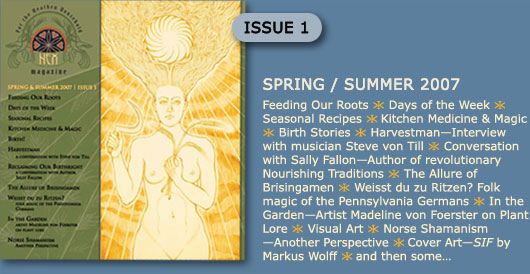
FEEDING OUR ROOTS
~ a rant from the editors

As soon as you name something you destroy part of it's vital essence. That being said, words have power and are useful for communicating ideas. For all practical purposes, we call ourselves Heathens, meaning we honor the beliefs and practices of Pre-Christian Europe.

If you look up 'Heathen' in a dictionary you will get various responses, mostly explaining it as "irreligious; unenlightened; rude; ignorant; uncultured; one who does not believe in God." Which is a pretty religio-centric point of view. Actually, we believe Heathenism to be full of culture, learning, and spiritual beliefs. As opposed to not believing in God, we believe in the existence of many Gods and Goddesses who keep us company, guide, and protect us. We trust our ancestral knowledge, and give testament to the old ways.

You might ask why we do this, why look backwards for answers?
Isn't it so much easier to just have one God to answer to? Shouldn't we just keep moving ever onward and forward? What about all of the conveniences of our modern age? Haven't advances in medicine and agriculture, manufacturing and telecommunications, improved our world?

We don't deny the age we live in, but we consistently find ourselves in opposition to the views and beliefs adhered to by modern, industrial culture. Industrialized society pays heed to ideologies that we find contrary to our survival, including a devotion to materialistic rather than cultural or spiritual values, progress at any price, quantity over quality, convenience rather than conscious responsibility for our actions. All degenerative moral values which cause waste and pollution, and which encourage arrogance and isolation, and eventually a loss of soul.

There has been a trend to conquer and assimilate, which we have observed marching on from the Roman Empire. A modernization process that spreads like a cancer (indeed cancer is unheard of in indigenous cultures). It puts the wants of the few over the needs of the many. It takes our language, our stories, our beliefs, our foods, and our land. It steals our belief in ourselves, our hearts, minds, bodies, and then our souls.

It has been consistently shown that as each group of people gives up the traditions of their ancestors, they invite the deterioration and destruction of physical and mental health, social structure, spirituality, the land and resources they depend on, and general well-being.

We have been taught that before the law and order of city states, the morality of Judeo-Christian religion, and the advancements of Western medicine, that people were sick animals who lived short, miserable, and violent lives. It's not true. If you study the findings of Dr. Weston Price, who traveled extensively around the world observing the last vestiges of truly indigenous culture, you'll find that the evidence does not support this statement. People who maintained their traditional diets of natural, organic, unprocessed, cultured foods lived to a ripe old age of 100-150! They were content and healthy, they had no physicians. They had upstanding morals and lived their lives without shame. They had no need to covet what their neighbors had, their doors had no locks. As each group of people consumed the homogenized and refined foods and culture of the industrial age, a process of decay began. He found that even over one generation the number of cases of birth defects, mental illness, depression, tooth decay, and degenerative diseases multiplied exponentially. After all, we are what we eat.

Technology is a tool and must be used properly, to support the growth and integrity of the people who it serves. It should not replace the wisdom of our traditions, or our spiritual and cultural values. The misuse of technology has wreaked destruction on our land and our people. Our ancestors knew that everything is connected. As the soil is poisoned, the trees cut down, and our crops blighted, so our souls are suffering. Our ancestors knew that the best way to fight disease is to remain healthy! The roots of our soul tree have withered and so we are sick. There is no miracle cure, no savior is coming to absolve us! Let us instead feed our roots by honoring the traditions and beliefs of those whose blood is the sap that fills our veins. Let us drink from that well and be nourished!
~ HEX magazine

[TOP]

Days of the Week
Ensio Kataja

I have been thinking about the days of the week. In Western cultures, the week commonly consists of five weekdays and two days of weekend. The Germanic gods, runes, and myths have left their traces in the very names of the days. This tells something of their enduring, Hidden power. In the Christian era, most of the older heathen day names were replaced with numbered day names (for example, Þórsdagr, Thor’s day, became Fimmtudagur, ‘fifth day,’ in Modern Icelandic). I will concentrate here on some relevant traditional knowledge related to original day names, mixed with my own subjective speculation.

Monday
‘Moon’s Day,’ Mánidagr, gets its name from Mani (Old Norse máni, Old English Mona), the Germanic Moon god (in the Germanic tradition, the moon is always masculine), and son of Mundilfari and Glaur. The Germanic myth tells how Mani pulls the moon through the sky and is chased by the wolf Hati. Lunar eclipses are the result, when Hati, Mánagarmr (’devourer of Mani’), comes close to succeeding. At the time of Ragnarok, Hati catches his prey, breaking it in his jaws. Monday is thus the appropriate day to pay attention to the moon cycles, the tides, and emotions, which have their own flow, rising and descending. Concentrate on the Mystery of laguz: see its effect and meaning in the context of your own inner cycles and changing life conditions. Delve deep into the world of your subconscious waters, feelings and intuition. Dive deeper and explore also the terrifying, darker and Hidden areas. Think about water and its relationship with the moon; read the rune poem of laguz.

Tuesday
Týsdagr in Old Norse, receives its name from Týr (in Old English, Tiw, Tew, or Tiu). Týr is a god associated with battle and war, but also with order, justice and law. Tuesday is thus good for dealing with legal matters, and putting all kind of things in order. Concentrate on the Mystery of tiwaz. Remember how Týr placed his hand in Fenrir’s mouth, think deeply about the concepts of order and self-sacrifice—what they are and what they mean to you. Is your life generally ‘in order’? What areas in your life and in yourself you would like to reorganize? The T rune is also the lot of troth (faith, loyalty, kinship). It is said that a man who does not flinch and surpasses others is said to be “as brave as Týr.” Spend time with your friends and family. Although it is important to plan things and to work methodically, don’t forget to also take action, instead of just endlessly planning. Follow Týr and victory will be yours.

Wednesday
Óðensdagr in Old Norse, Wodnesdæg in Old English, is the day of the Germanic god Woden, more commonly known as Odin. Speech is the appropriate word for Woden’s Day. On Wednesday, dwell deeply in the Mystery of ansuz and see where that leads you. On some future Wednesday, I also recommend that you undertake the following Working—be intensely conscious of what you say, how you speak, and be aware of what others say and what they really mean as well. Try to say what you mean and mean what you say, but also learn to use words creatively, according to your Will and goals. Hone your skills in the use of language(s) but avoid the inane, unconscious, babble that only degrades your very being.

Thursday
Þórsdagr in Old Norse, Þunresdæg in Old English, is the day of Þunor, commonly known in Modern English as Thor, the Germanic god of thunder. Concentrate on the Mystery of thurisaz. Become aware of your temper and changes in mood. Learn to use this knowledge consciously. Learn to defend yourself physically, but make sure you don’t ever sink to the level of a mindless bully. Dedicate this day to the god Thor. Learn why he was very much the favorite deity of Scandinavians, but also think about his important role in the Aesir’s war against the thurses, the forces of unconsciousness and primordial nature.

Friday
Friádagr in Old Norse, frigedæg in Old English, from the Germanic compound frije-dagaz, is Freyja’s (and/or Frigga’s) Day. Friday is thus good for explorations of sexuality and workings of seidhr. Dedicate this day to Freya through all possible actions. Concentrate on the Mystery of fehu; this rune is feminine, and connected to Freya, who is a goddess of love, beauty, fertility, wealth, and war. The reconstructed Germanic word *frijaz means ‘beloved, belonging to the loved ones, not in bondage, free,’ from the Indo-European root *prei-, and Germanic *frijon, ‘to be fond of.’ It has been suggested that the original meaning of *frijaz was probably something like ‘from one’s own clan,’ from which the meaning ‘being a free man, not a serf’ developed. Consider also the word *frijj, ‘beloved, wife.’ Friday offers a complex Mystery—what does this tell you about Freyja’s nature as well as of the binding and freeing of things, objects, and even people? What about Frigga—Seeress, protectress, goddess of married women and of the home, who complements Freyja’s functions (perhaps a more appropriate rune for Frigga is perthro instead of fehu)? Think about what freedom really means. Don’t pursue its meaning only in the shallow contemporary sense, but rather as it relates to our tradition.

Saturday
‘Dies Saturni,’ or ‘Saturn’s Day’ is the only day of the week to retain its Roman origin in English. However, my personal opinion is that Saturday (laugardagur in Old Norse, the traditional day for washing and bathing in Scandinavia—pointing to the Mystery of laguz), could also be associated with Loki. Thus, it is a day suitable for pranks, and for changes in general. More specifically, Loki, the Lord of all Fools, rules over April’s Fool’s Day, and if you ask me, any day when you experience a maelstrom of not-so-happy events that in the end force you to laugh. Loki is a Trickster who can easily upset people with no sense of humour. During Saturday, then, meditate on the importance of not taking everything, including yourself, so seriously all the time. Meditate also on the role of conflict, strife, and change, and your personal capacity to handle such things. Instead of seeing Loki as some dualistic archvillain or a creature of monstrous evil, I suggest you entertain the thought that he is actually Odin’s shadow side, who helps to keep the multiverse in equilibrium. With enough Lokean conflict, strife, and change, life will at least never be too boring. Those brave and foolish enough may invoke Loki on Saturday. The runes I instinctively associate with him are kenaz, thurisaz, and ansuz. If there is any bit of a rebel and a trouble-maker in you, you will understand why. (I wanted to keep this text on Saturday short, but see how long it became; obviously, Loki made me do it...)

Sunday
Sunnundagr in Old Norse, gets its name from Sunna, or Sunne the Germanic sun goddess. In the poetic Edda, Alvíssmal says, “It is called Sól among men and Sunna among the Gods. On the Day of the Sun, embrace the higher being in yourself by meditating on the Mystery of Sowilo.” Understand why the S rune represents both a guide and a goal sought after by the runester. Make plans for the coming week and concentrate on your primary goals. If you feel you are stuck in a frozen situation, the light of the archetypal sun can melt even the thickest ice and set you free. The holy solar wheel spins and keeps things in dynamic motion. Follow the path of the serpent on Sunday and you will find many a Hidden thing.

[TOP]

Kitchen Medicine & Magic
Teresa Luedke

The hearth was in the midst
of the dwelling
that hearth was to each member
of the household
as it were, an umbilicum orbis,
or navel of the earth...


William R. Lethaby (18 57–1931 ),
English architect and architectural historian

In each issue, this column will explore commonplace medicinal/
magical foods & tools in our 21st-century kitchens—many
of the very same resources found at heathen hearths a thousand
years ago. By investigating history, Norse sagas, and other
folklore, we hope to rediscover some of the lost ancestral knowledge
and power in our own kitchens. This section hopes to deepen
our spiritual connections to, and enhance ritual workings of,
heathenry as a folk religion as well. Our premier article introduces
three elements found in both cooking and creation lore, with ideas
for their use in your spring rituals—fire, water, and salt.

Medicine and Magic
The modern mind may think of medicine and magic as being in opposition
to each other, but both share the ability to change reality and alter energy.

Consider this—you find yourself feeling the symptoms of a cold and decide to eat some chicken soup. Like most people, you’ve probably heard it’s good for illnesses such as that. Before long you realize that you’re actually feeling better. You have just changed your reality by altering your energy! Both the medicine from the nutrients and the magic from your intentions (for starters) were in the soup, and your body has utilized both to bring about better health. Nutrients contain energy that we know exist, however intention is also a very real energy and has an influence whether directed or not. We see this demonstrated in the scientifically
proven placebo effect. You think you will get better and you do. Imagine
the possibilities when consciously using this ‘magic’ with ‘medicine’!

Kitchens—The Heart(h) of the Home
Our kitchen is the place “in the midst of the dwelling” and here is where
the stone hearths of old link to stoves of today. In fact, one source claimed Scandinavians introduced the cast-iron stove to the American Colonies in the 18 th Century and from this ‘Norse stove’ sprang the
American cooking stove of today.(2) So their hearth really is our hearth.

My own kitchen contains objects to keep the household in touch with our
ancestors, the Gods and Goddesses, and yes, the wights. Frigga is represented by a string doll I made a few years ago, and she hangs near my sink. I tie objects to her skirt as offerings representing blessings or healings I may be working on. She connects me to our family’s ancestral mothers, the ‘dis’ or ‘idis’ whom I greet each morning with a pat and a plea to look over the family that day. On my stove is a small statue of a cow to represent Audhumla, whom I tip my morning coffee to. A small jar of mixed salt and herbs with the words “Are you worth your salt?,” also has a place. Leftover foods go into a container on the stove. House
wights get first pick of their essence, and then land wights work them over in the compost pile.

Sometimes when I’m doing mundane tasks for my family like stirring bread batter or rinsing dishes I feel like my ancestors are there with me, superimposed upon my body, all of us stirring or rinsing together; sharing the same ‘navel.’ I can only describe this as feeling like I am part of an echo, an echo created by a task being repeated countless times over many generations. This echo somehow turns the threads connecting us into a time machine, allowing us to enjoy these mundane tasks of everyday life together.

In this ordinary kitchen is where many of the common tools, supplies, and plants of medicine and magic can be found. In fact, three of these elements reach all the way back to the beginning…

Basic Elements of Cooking and Creation
—Fire, Water, and Salt

By reading (yeah, homework) the Edda of Gylfaginning(1) also called The Tricking of Gylfi, we can learn that these elements, accessed daily in our kitchens, were present at the very dawn of time. Gangleri asked “What was the beginning? And how things start? And what was there before?.”(1)

Briefly the Edda says; Muspelheim was a land of “flaming and burning”(1) and Niflheim the home of “a spring called Hvergelmir.”(1) These two forces begin to interact and over time the frost giant Ymir, along with the cow Audhumla, emerge. Audhumla then begins to lick “the rimestones, which were salty”(1) and uncovers Buri, “a complete man.”(1) Later the descendents of Buri overcome Ymir and drag him into the center of Ginnungagap where they use his body to create the earth, sea, sky, clouds, rocks, and trees—everything that makes up Midgard. So we find from the very beginning of time, fire, water and in its turn, salt, as the building blocks of everything we know in this life.

We can begin to utilize the elements of Ginnungagap, by acknowledging our kitchen sink as a connection to the original spring, Hvergelmir, at the heart of Niflheim; and our stove as a link to the hearth fires of old and the original fires of creation, Muspelheim.

Fire Lore
“Fire is needful…”(4) Today the fires at our hearth have been somewhat tamed. With the flip of a switch, electric lights, toasters, coffee pots, water heaters, microwave ovens, and various other kitchen appliances come to life. All of these ‘fires’ could be considered descendents of the primal fires of Muspell. Fire was used by our ancestors in rituals and rites and was often considered an honorable way to see those, who had passed from this life, off to the next one.

Folklore, including charms and rituals from Scotland, show that magic seemed to be evident in wood and fire and that it should certainly be honored and treated with respect. Charms were used for all aspects, from gathering the fuel, to starting the fire in the morning. Women would recite charms and pray in a low tone that the fire may be a blessing to her and to her household.(2) See the charm for “Smooring The Fire”(2) on page 13, that could easily be adopted for today—perhaps at the end of the day when you finish in the kitchen.

Several contemporary authors explore the significance of fire in their books, often attributing a magical and spiritual connection. Author and Germanic Heathen, James Hjuka Coulter, describes the Need-fire as “A Holy cleansing flame; used in ritually clearing a sacred space or in magical functions such as healing. (MoHG Notfeuer).”(5) I particularly like his advice to bring good luck into the home by taking soil from the newly plowed garden, or other land, in the spring, and placing it under the hearth/kitchen stove and in the four corners of the house.(5) Kate Dooley takes a slightly more modern look into ‘hearth-keeping’ and the ‘need-fire’ by sharing insights and ideas for seasonal and daily practices incorporating the hearth, fire and the goddess of the hearth, Frigga.(11) The kindling of a need-fire, and a ritual taking of soil as a sacred connection to our environment, are both practices that could fit well into most spring rituals.

Water Lore
“Water is needful…”(4) Very needful—our bodies are composed of about 70% water. Today water is so simple to access that we forget how central it is to our lives. If we had to haul buckets full daily to the hearth, we’d quickly develop a new appreciation for it. Old recipes and spells often list spring water as an ingredient.

In folklore, strong energy has been associated with water. The Norns certainly have shown us water’s power when they “pour[ed] it up over Yggdrasil so that it does not rot or decay.”(2) The Old English Herbarium #86(4), tells of an interesting use for spring water found under the listing for Wood Chervil: “If any evil man bewitches another through ill will, take this same plant’s roots dried, give to eat with spring water and sprinkle him with that water, he will be unbound [from the spell].”(6)

The veneration of water sources were some of the last strong-holds of old world heathen/pagan beliefs and are still reflected in such traditions as wishing wells. These beliefs were able to exist well into the Christian era, “separate from religion, as a form of nature worship”(12) and certainly incorporated nature spirits and perhaps ancestors. The old world honoring of the water source is certainly something to consider incorporating into our own kitchens.

Salt Lore
Salt or sealt is a six-sided cube called ‘sodium chloride’ by chemists and is formed when an acid and a base interact—a lot like when fire and ice react.

Leechcraft lists 29 instances of salt in folklore formulas, with uses ranging from salt scrubs, purgatives, bloating, boil treatments, and heartburn; as a part of salve for warts, stings, bites, and other wounds; for foot problems; and as an ingredient to cure insanity and elf sickness!6 Some folk remedies refer to salt that is white as opposed to the common brown salt. Sometimes the salt is burnt first.

Salt had a lot of influence on Europeans because some areas had access to the mineral, while others had to import it. It is responsible for many ‘salt roads’ where it was sometimes called ‘white gold.’ One such road was called ‘The Old Salt Route’ (German: Alte Salzstraße).

Dried and salted fish such as herring and cod were staples of the European diet by the 12th century, saving much of the population from starvation.(2) Many then developed a taste for this salty food and continue to make it today.

Remember, refined table salt is a poor choice for human consumption. It is heatprocessed and bleached with chemicals to make it white. Then another chemical, aluminum stearate, is added so that the salt flows well without clumping. Instead look for natural salts like sea salts created by evaporation from the sun. See several old world uses for salt in the side bars.

Ideas for Modern Ritual
Since spring is a time of beginnings, perhaps rededicating the kitchen stove/ hearth each year or solstice could become a part of this holy tides festivities. Creating a kitchen altar or incorporating images of your gods and goddesses, as Scandinavian housewives did when coming to their new husband’s hearth, can help build the energy of a heathen kitchen.(2) Use the kitchen hearth-fire (stove), even if electric, to kindle the holy fires of the home. Put some fertile garden soil under the stove for the wights. Leave offerings to honor your water source and use salt in the spring rites. Take the time to read some lore concerning water and wells, fire, salt, and hearths.

I hope this peaks your interest in folklore, and in turning your kitchen into a place that helps a heathen define who they are. This spring, pull out your favorite folklore sources and see what you can find to help cultivate the medicine and magic in your home. Let the idea of the intertwined elements of cooking and creation remind you of the power held in our everyday tasks.

Until Winter Solstice, may the gods and goddesses bless your hearth.

Read a recipe for Gravlox. For more recipes and kitchen tips, read the Spring Issue of HEX magazine. We’d also love to hear if and how you incorporate fire, water, and salt into your Spring rituals, so send in your comments to hex address:
hearthfire@hexmagazine.com

References
1.) Everyman Edda (University of Birmingham: Everyman Paperback Classics, re-issue 2004)
2.) Dale Brown and the Editors of Time-Life Books, Foods of the World; The Cooking of Scandinavia, revised edition (1981). Coincidentally while researching this article a trip to the local Goodwill thrift store yielded this new source of lore for our heathen kitchen. Mr. Brown was introduced to Scandinavia while studying literature in Copenhagen, on a Danish
government fellowship, in 1953. He returned many times after that. His love of the country, its mythos and its food, is evident in all the pages. Homework sure can be fun.
3.) Alexander Carmichael, Oliver and Boyd, Carmina Gadelica, Hymns and Incantations, vol.1 (Edinburgh: Scottish Academic Press, 1928 )
4.) The Poetic Edda, trans. Carolyne Larrington (Oxford Paperbacks, 1999)
5.) James Hjuka Coulter, Germanic Heathenry, A Practical Guide (2003)
6.) Steven Pollington, Leechcraft—Early English Charms Plantlore and Healing (Anglo-Saxon Books, 2001)
7.) www.saltinstitute.org
8.) Elson M. Haas, M.D., Staying Healthy With The Seasons (Celestial Arts, 1981)
9.) www.cookingwithengineers.com
10.) Readers Digest; Back to Basics, (Readers Digest Association, Inc., 1981)
11.) D. Kate Dooley, The Spindle Hearth (Yarrow Press, 2006)
12.) Karen L Jolly, Popular Religion in Late Saxon England (The University of North Carolina Press, 1996)

[TOP]

Birth!
Birth stories by four women, Amie, Pattie, Katherine, and Arrowyn.

Read more in the Spring Issue of HEX magazine.

[TOP]

Harvestman
Conversation with Steve von Till conducted by Cody Dickerson for HEX

Haunted by the voices of generations past, Steve Von Till’s delicate and intense songs have the rare ability to speak for one while they speak for us all. The music is simultaneously universal and personal—with each exposed nerve of the artist’s life, it demands that we reveal the same.

Read more in the Spring Issue of HEX magazine.

[TOP]

Reclaiming Our Birthright
Conversation with Sally Fallon conducted by A von Rautmann

Sally Fallon’s obsession with traditional nutrition started with motherhood and a love of cooking. In researching the healthiest way to feed her family, she discovered the writings of Dr. Weston Price. This information
became a powerful weapon against the dangerous crusade for a low-fat diet, which is especially harmful for growing children, Fallon teamed up with Dr. Mary Enig and went on to write Nourishing Traditions, the cookbook that recalls “the culinary customs of our ancestors.” In 1999, with the publication of the 2nd edition, The Weston Price Foundation
was established to further spread the word on our birthright of “physical perfection and vibrant health.”

Read more in the Spring Issue of HEX magazine.

[TOP]

The Allure of Brisingamen
Alison Grandmason a.k.a. Swanhilde

Throughout Norse mythology there are references to the Goddess Freyja, famed for her beauty and for her possession of the mighty necklace
called Brísingamen. The necklace was forged by four dwarves and acquired by Freyja in exchange for sexual favors. While many modern texts refer to this mysterious piece of jewelry, few provide any information as to its function or significance. For that reason, this item has held great interest for me. I have considered the relevance of this piece of jewelry for several years, and this article represents the culmination of my studies. The Brísingamen is mentioned infrequently throughout the older texts, but when it is, there are clues as to its character. Coupled with what we know about Freyja and the lore that surrounds her, we will investigate this mystery through translations
of old texts and examine the significance of the Brísingamen to its divine owner, the goddess Freyja.

Read more in the Spring Issue of HEX magazine.

[TOP]

Weißt Du Zu Ritzen?
Do you know how to Carve/Scribe/Write?
Cody Dickerson

The German title Weißt du zu Ritzen? originates in the Hávamál
of the Poetic Edda, strophe 14. It translates as “Do you know how to write/carve?” Here, Óthin asks eight questions regarding the proper magical use of runes (Old Norse Rûna, or mystery), and illustrates the extremely archaic use of written arrangements in Germanic magic. It also appears here in a variant of Fraktur, a blackletter typeface popular among the Pennsylvania Germans for use in important documents such birth, marriage and death certificates.

Read more in the Spring Issue of HEX magazine.

[TOP]

In the Garden
Madeline von Foerster—an artist's lore of plants

What plants contribute to our world is something beyond measure, or
even description. It is common to view plants as nonentities separate
and less important than ourselves, without comprehending that their
existence is the keystone of our own. Their minute alchemy transforms
inorganic matter into something we can ingest, transforms carbon dioxide into something we can inhale. In the web of life on Earth, plants provide the most significant strands.

My painting, In the Garden, is my love-letter to Kingdom Plantae. Surrounding us are plants with myriad and marvelous properties, each unique species able to fulfill some different exigency of our bodies or spirits. They feed us, shelter us, clothe us, heal us, intoxicate us, and delight us with their beauty and fragrance. Abstractly, they decorate our temples and bodies, inspire our myths, and give us comfort with their very beings.

The style of In the Garden is inspired by the tapestries of medieval Europe, a period in which the divide between medicine, botany, and art did not yet so clearly exist. Looking at these tapestries, so richly embellished with botanical images, one is amazed at how carefully
the plants are depicted—individual species are readily discernible. An
astounding amount of toil is required for such detailed weaving. Because
of this source of inspiration, and my interest in the medieval era in general, I thought it would be interesting to explain what some of the plants I selected for the painting meant—their symbolism, usage, folklore, and history. With one or two exceptions, the plants in the painting were familiar to medieval Europeans, and can be easily found in art from that era. This article will be continued in the Fall. ~MVF

Read about Forget-me-not, Blackberry, Sage, and Chamomile in the Spring Issue of HEX magazine.

[TOP]

Norse Shamanism—Another Perspective
Valúlfr Vaerulsson

Preliminary Remarks
The purpose of this article is to proffer an in-depth perspective on the relationship between Óðinn and Heimdallr, within the general framework of the term ‘hypostatic’ which will be defined in due course. In addition to shedding more light on the fragmentary remains of the Heimdallr myth, it will also be shown that the ancient Germanic religio-magical initiatory tradition contains many parallels to the north Asiatic shamanistic
traditions, the Soma rituals of the Vedic tradition, and various other Indo-European traditions. Although this is not a study on the origins of technique or religious views, it is interesting to note the following by Prof. Jere Fleck of Maryland U.: “It seems far more likely that such parallelism
is due to Germanic preservation of inherited tradition on the one hand, and central and north Asiatic borrowing from, or via Iran on the other.”

In order to show the relationship between these two Norse gods we need to begin with a general view of shamanic and Germanic cosmology and how they relate to each other. The Vedic traditions of India, and their ‘cousins’ the Persians, will also be examined as they preserved the oldest texts and concepts of our eastern Indo-European brothers. And while what is being offered is not the final word on the subject, it will nonetheless provide an intellectual ‘spring-board’ whereby subjects like
this can be further investigated.

Words which are italicized are my addition to various quoted texts or for emphasis.

Read more in the Spring Issue of HEX magazine.

[TOP]

<empty>

HARVEST  |  HEX HAILS!  |  HEX FOLK  |  SUBSCRIBE  |  SUBMIT!  |  ARCHIVE
HOME  |  CONTACT  |  NEWSLETTER  |  ADVERTISE   |  GUESTBOOK

© 2007 HEX Press | Site Created by Arrowyn Craban / Verdandi Design

<empty>